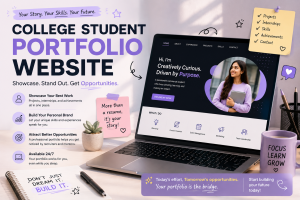
Your degree tells people what you studied. Your college student portfolio website shows them what you can actually do.
Being a college student today isn’t just about attending lectures, completing assignments, and waiting for graduation. You’re building projects, joining societies, completing internships, learning new skills, and discovering what kind of professional you want to become. A college student portfolio website gives all these experiences a place to come together, helping you showcase your skills, achievements, projects, and growth in one professional space..
A well-designed portfolio brings your experiences, skills, projects, achievements, and goals together in one place—giving recruiters, internship providers, and potential collaborators a better idea of who you are.
The Problem: Your Best College Experiences Are Easy to Miss
Think about everything you’ve done during college.
Maybe you’ve worked on a group project that you’re genuinely proud of. Maybe you’ve helped organise a college fest, worked with an NGO, completed an internship, designed something on Canva, managed a small project, participated in a competition, or developed a skill outside your course.
However, now imagine putting all of that into a one-page resume.
Unfortunately, it simply doesn’t fit.
That’s one of the biggest challenges students face while applying for internships. You may have valuable experiences, but a recruiter might only spend a few seconds looking at your resume.
Moreover, let’s be honest—being told that you’re “hardworking”, “creative”, or a “team player” doesn’t mean much without proof.
A student experience portfolio gives you the space to show that proof.
For example, instead of simply saying”I have event management experience,” you can explain what you worked on, what your responsibilities were, what challenges you faced, and what you learned.
As a result, that’s a much stronger story.
Your experiences already have value. Your portfolio simply gives them a place to speak.
Why a College Student Portfolio Website Matters for Your Career
In fact, a college student portfolio website isn’t just an online version of your resume. Think of it as your personal professional space.
It’s where someone can understand your journey without having to piece everything together from different platforms.
For example, a recruiter looking for an intern could find:
- Your education and academic background
- Previous internships and work experience
- College society or student council involvement
- Projects and competitions
- Skills you’re developing
- Certifications and achievements
- Creative work or case studies
- Your career interests and goals
- A simple way to contact you
As a result, this creates something a resume often can’t—a complete picture of you.
It can also make your internship applications more memorable. Instead of sending another PDF that looks similar to dozens of other applications, you can include your portfolio link and give the recruiter something interactive to explore.
How a Student Intern Portfolio Can Help You Stand Out
A good student intern portfolio doesn’t need to contain dozens of impressive projects.
In fact, quality matters more than quantity.
That said, if you’ve only completed one internship, include it ; or you’ve worked on two meaningful college projects, showcase them ; or you’ve organised an event or contributed to a student organisation, explain your role.
Ultimately, the goal isn’t to make yourself look like someone with ten years of experience.
The goal is to show how you’re growing.
To make each experience more meaningful, try answering four simple questions:
What did I do?
Explain your role and responsibilities.
Why did it matter?
Describe the objective or purpose of the project.
What did I learn?
Mention the skills, knowledge, or lessons you gained.
What was the outcome?
>>>>>>>>>>>>>>>>>>>>>>Whenever possible, include measurable results—such as participants managed, tasks completed, campaigns created, or targets achieved.</p></p>
For instance, instead of writ
ing:
“Helped organise a college event.”
You could write:
“Worked with the event team to coordinate a two-day college fest attended by 1,000+ participants, supporting planning, coordination, and on-ground execution.”
As you can see, the second version immediately gives the reader more context.
That’s the power of a student experience portfolio.
Benefits of a College Student Portfolio Website
Creating a college student portfolio website can help you in more ways than just internship applications.
1. Make Your College Student Portfolio Website More Memorable
Recruiters see countless resumes. A personal website gives them something different to associate with your application.
Your work becomes more than a list of bullet points.
2. Showcase Your Work Through a College Student Portfolio Website
A resume says what you have done.
A portfolio can actually show it.
You can include screenshots, project outcomes, presentations, designs, certificates, event photographs, writing samples, or other relevant work.
3. Build Your Professional Identity With a College Student Portfolio Website
You don’t have to wait until graduation to start building your professional presence
Your college years are when your interests, skills, and experiences begin taking shape. Documenting them early means you’ll have a stronger professional identity by the time you graduate.
4. Use Your College Student Portfolio Website for Internship Applications
When you’re applying for a college student internship, having a portfolio link can make it easier for employers to understand your capabilities.
Instead of explaining everything in an email or resume, you can simply direct them to your website.
5. Show Initiative Through Your College Student Portfolio Website
Building something of your own demonstrates that you’re willing to take initiative.
For a student, that’s valuable.
A portfolio doesn’t have to be perfect. What matters is that it reflects effort, growth, and genuine work.
What Should You Include in a College Student Portfolio Website ?
Not sure what belongs on your website? Start simple.
A strong college student portfolio website can include the following sections:
About Me
Give visitors a quick introduction to who you are, what you’re studying, what interests you, and where you’re hoping to go professionally.
Keep it personal—but professional.
Education
Mention your college, degree, expected graduation year, and any academic achievements that are relevant.
Experience
Add internships, part-time work, volunteering, freelance projects, and meaningful college responsibilities.
Your student intern portfolio should focus on what you contributed rather than simply listing job titles.
Projects
Showcase academic, personal, or professional projects. Explain the problem, your contribution, and the outcome.
Skills
Include both technical and soft skills that you’re genuinely developing. Communication, leadership, event coordination, research, problem-solving, project management, and teamwork can all be valuable depending on your career direction.
Achievements
Competitions, awards, certifications, scholarships, leadership positions, and other accomplishments can help strengthen your profile.
Contact
Make it easy for someone to reach you. Include your professional email, LinkedIn, or another appropriate contact method.
A portfolio should make it easier—not harder—for someone to understand your journey.
How to Build Your College Student Portfolio Website Step by Step
You don’t need to spend months creating one. Start with the information you already have.
Step 1: Collect Your Experiences
Make a list of your internships, projects, societies, events, competitions, certifications, volunteering experiences, and achievements.
Don’t worry about making everything sound impressive yet.
Just collect it.
Step 2: Choose What Represents You Best
You don’t have to include everything you’ve ever done.
Select experiences that reflect your interests and the kind of opportunities you want next.
If you’re interested in HR, for example, experiences involving recruitment, teamwork, employee engagement, coordination, or leadership may deserve more attention.
Step 3: Turn Experiences Into Stories
For every major experience, explain your role, responsibilities, skills developed, and results.
This is where your student experience portfolio becomes more meaningful than a basic list of activities.
Step 4: Organise Your Website
Keep the navigation simple.
A visitor should be able to understand who you are within seconds and find your most important work without clicking through endless pages.
Step 5: Add Visual Proof
Where appropriate, include photographs, project screenshots, certificates, presentations, designs, or other examples of your work.
Visual evidence can make your experience much easier to understand.
Step 6: Keep Updating It
Your portfolio isn’t a one-time college assignment.
Every internship, project, achievement, certification, or meaningful experience can become another part of your professional story.
Start small today, and you’ll thank yourself when internship and job applications start coming in.
FAQs About College Student Portfolio Website
1. Do college students really need a portfolio website?
Not every student needs one, but it can be a strong advantage—especially if you’re applying for internships, showcasing projects, building a personal brand, or entering a competitive field.
2. What should a student intern portfolio contain?
A student intern portfolio can include your education, internships, projects, skills, achievements, certifications, extracurricular activities, and examples of work. Focus on experiences that support the opportunities you’re looking for.
3. Can I create a portfolio without having a lot of internship experience?
Absolutely.
Your portfolio can include college projects, volunteering, society work, competitions, event participation, freelance work, personal projects, and skills you’re developing. You don’t need years of experience to start documenting your journey.
4. Is a portfolio useful when applying for a college student internship?
Yes. A portfolio can give employers additional context about your skills and experiences beyond what’s possible on a resume. It can be particularly useful when you have projects or achievements that you want to demonstrate visually.
5. How often should I update my student experience portfolio?
Ideally, update it whenever you complete something meaningful—a new internship, project, certification, competition, leadership role, or achievement. Small updates throughout college are much easier than trying to rebuild everything right before graduation.
Your College Journey Is Worth Showcasing
You don’t have to wait until you’re a graduate with years of experience to build a professional identity.
Your college journey is already full of stories—your first internship, the event you helped organise, the project that challenged you, the competition you entered, the skill you taught yourself, and even the experiences that didn’t go exactly as planned.
A college student portfolio website brings those experiences together and turns them into something people can actually see.
So, don’t wait until your resume feels “good enough.”
Start with what you have. Keep learning. Keep adding to it. Let your portfolio grow alongside you.
Your college experience is more than a degree. Give it a place to be seen.